

Image: Drone shot of the North Saskatchewan River as it flows through the City of Edmonton on a stormy day.
Photo credit: Ryan Northcott
The North Saskatchewan River (NSR) has recently earned recognition as a Canadian Heritage River, acknowledging its deep cultural, historical, and ecological significance. Beyond its legacy, the river’s current health is vital as it continues to sustain the communities and ecosystems that depend on it.
To understand this, the North Saskatchewan Watershed Alliance (NSWA) completed a new State of the Watershed assessment in 2025—the first since 2005. The new comprehensive approach uses the Freshwater Health Index (FHI), a global framework that evaluates watershed health through three lenses: ecosystem vitality, ecosystem services, and governance and engagement. By combining scientific data with insights from stakeholders and rightsholders, the assessment offers a holistic view of current conditions.
The big picture is cautiously optimistic. The NSR mainstem remains in good condition, with strong water quality and reliable supply. Across the broader watershed, water availability is stable and not over-allocated, suggesting a resilient system.

Image: A high alpine perspective of the North Saskatchewan River at Whirlpool Point.
Photo credit: Melissa Jenkins
A closer look reveals emerging pressures, as some tributaries show stress with more unpredictable flows. Certain creeks now face frequent extremes, from high flows to prolonged low flows, raising concerns about long-term stability.
Water demand varies across the watershed. Industry is the largest surface water user, far exceeding residential drinking water use. While groundwater is a critical resource for agriculture, its interactions with surface water are not well understood. In some areas, allocations are nearing theoretical limits, which could raise the risk of ecological impacts.
Water quality remains generally good but shows signs of degradation in developed regions where urban, industrial, and agricultural activities overlap. Lower water levels can increase the concentration of contaminants, while both runoff and point‑source pollution continue to pose risks.
Beyond water itself, the health of the surrounding landscape tells an important story. More than half of the watershed’s original natural areas have been lost, and what remains is often fragmented. Riparian zones, key buffers for waterways, are widely altered, reducing their ability to filter pollutants and manage floods. Habitat fragmentation also disrupts wildlife movement and reduces biodiversity.
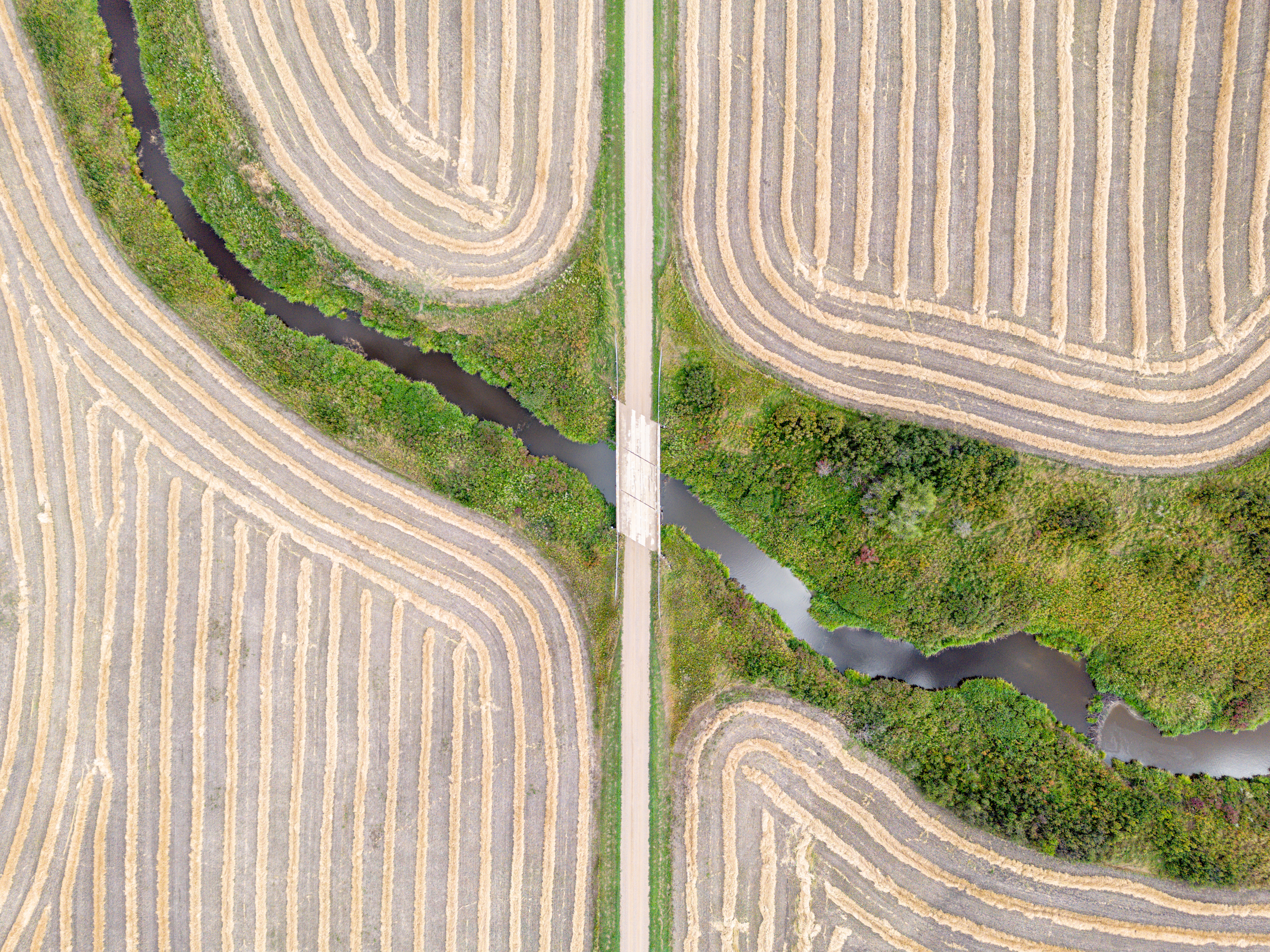
Image: An aerial shot of the Vermilion River, a tributary to the North Saskatchewan River, as it flows through agricultural lands and under a bridge, surrounded by a nice, intact riparian buffer that serves to slow runoff and pollutants from entering the water.
Photo credit: Steve Ricketts
Aquatic ecosystems are also strained, as some fish populations decline while invasive species degrade habitats and compete with native species. Although few species are officially at risk, limited monitoring makes trends hard to assess.
Governance adds a layer of complexity. While management frameworks exist, stakeholders note gaps in clarity, enforcement, and coordination. Weak enforcement and reliance on voluntary compliance suggest room to strengthen water management and protection.
Despite challenges, the watershed is not in crisis but at a crossroads. Its overall health remains strong, yet growing pressures from climate change, land use, and demand are testing its resilience.
The path forward is to protect what works while addressing gaps through better monitoring, better enforcement, improved understanding of groundwater, and restoring ecological connectivity. It also requires sharing watershed benefits more equitably across all communities.
The North Saskatchewan River has supported life and livelihoods for generations and can continue to do so with thoughtful, integrated management.
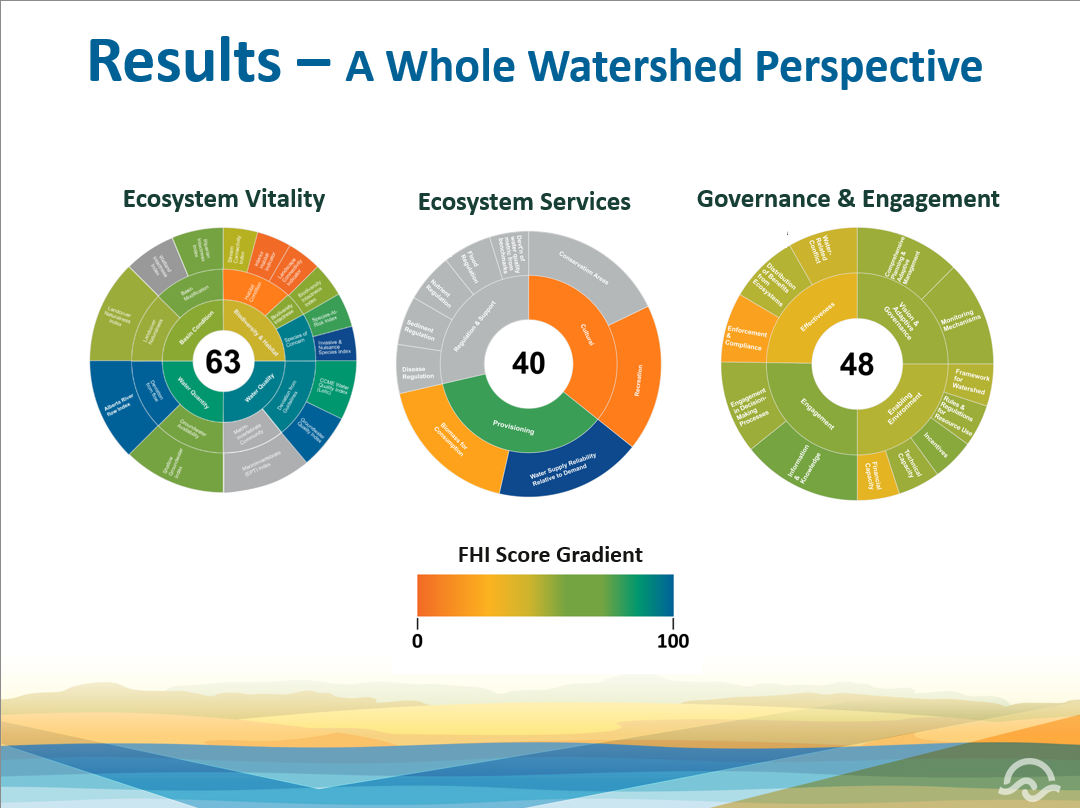
Figure 1. The 2025 State of the Watershed results for the North Saskatchewan River watershed using the Freshwater Health Index. This high-level perspective of the results portrays the three conceptual dimensions of the FHI: Ecosystem Vitality, Ecosystem Services, and Governance & Engagement. These colourful wheels are made up of the indicators (inner most ring), sub-indicators (middle or outermost ring), and indices (outermost ring for Ecosystem Vitality) used to assess the dimensions, and the colors represent their scores on a scale of 0-100. Scores on the more orange side, closer to zero, indicate poor condition and those on the blue side indicate good condition. Sections in grey represent where knowledge gaps exist. The score in the middle of each wheel is the composite score for that dimension as the geometric mean of the indicator scores. This is meant to provide an average condition for the watershed, given all the factors that were assessed.