
From October 6–10, 2025, the Canadian Parks Council (CPC) and Canadian Heritage Rivers System (CHRS) came together for Congress 2025 at the Wilderness Edge Retreat & Conference Centre in Pinawa, Manitoba. This year’s Congress was co-hosted by Nunavut Parks and Manitoba Parks, showcasing a powerful example of interjurisdictional collaboration and cultural exchange.
We extend our heartfelt thanks to the Nunavut Parks team, who traveled great distances to lead, host, and enrich the Congress with their knowledge, warmth, and cultural traditions. Their contributions were central to the success of this year’s gathering.
Here are a few highlights from the week:
Arrival
Monday activities set the tone for a week of connection and learning. Leadership Residency students and Canadian Parks Council delegates were welcomed with a visit to the Winnipeg Art Gallery’s Inuit Art Centre (Qaumajuq), offering a powerful introduction to Inuit culture and artistry. The day continued with a guided excursion to Fort Gibraltar in Whittier Park, where participants explored the complex cultural landscape of Winnipeg and reflected on how the National Urban Parks model—centered on conservation, connection, and Reconciliation—intersects with existing park systems.

Image: Sculpture at the Winnipeg Art Gallery
Photo Credit: Laurel Finney
Awards Ceremony & Banquet
The Awards of Excellence ceremony on Tuesday evening celebrated outstanding leadership and innovation in parks and river stewardship, with awards jointly presented by the Canadian Parks Council for park leadership and by the Canadian Heritage Rivers System for exceptional contributions to river stewardship.
The Canadian River Heritage Award was presented to Elder Sheila De Corte in recognition of her lifelong advocacy for rivers and water, a testament to the deep cultural and ecological connections that guide our work. Founder of For the Love of the Rivers, Elder Sheila De Corte is a revered knowledge keeper whose ceremonial water walks and teachings inspired youth and communities across Turtle Island to embrace Indigenous water stewardship.
Abby Nagel of Saskatchewan Parks received the Micah Messent Award for her exceptional work in collaboration, mentorship, and strategic partnerships. Shelley MacLean, also from Saskatchewan Parks, was honoured with the Individual Award of Excellence for advancing meaningful relationships with Indigenous communities, organizations, and schools.


Images: Canadian Parks Council award recipient Sophie Fournier receiving a certificate on behalf of Sépaq (left) and Elder Sheila De Corte holding her award – a beautifully carved and wood burnt canoe paddle (right).
Photo Credits: Joanne Podolchuk (left) and Sheila De Corte (right)
The Operational Award of Excellence went to Graham Brittain of Alberta Parks for improving safety and environmental sustainability at a popular but hazardous natural site. Finally, two Agency Awards of Excellence were presented: one to Sépaq, accepted by Sophie Fournier, for their successful and collaborative solar eclipse event at Parc national du Mont-Mégantic, and another to Ontario Parks, accepted by Jason Travers, for their innovative Human-Wildlife Conflict Reporting Tool.
Field Excursions
On Wednesday, October 8, Congress participants took part in four immersive field tours across Nopiming and Whiteshell Provincial Parks, each designed around a unique theme to spark reflection, learning, and connection.
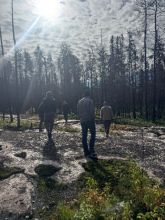
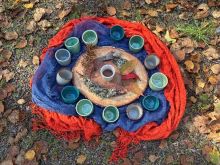
Images: Participants hike through a fire-scarred landscape in Nopiming Provincial Park, observing ecological recovery in a recently burned area (above). Vibrant scarves encircle delicate teacups, creating a warm and inviting setting for reflection or conversation (below).
Photo Credit: Sue Hamel
At Nopiming Provincial Park, attendees visited Black Lake Campground to observe wildfire damage and discuss Manitoba Parks’ coordinated response, infrastructure loss, and the impacts on woodland caribou habitat.

Images: ‘Forester’s Footsteps' hike in Whiteshell Provincial Park.
Photo Credit: Marleine Gélineau
In Whiteshell Provincial Park, three distinct tours unfolded: a visit to the sacred Petroforms of Manito Ahbee, where participants explored Indigenous rights, land claims, and stewardship challenges; a hike along the Forester’s Footsteps Trail, focused on forest health, pest management, and fire resilience; and a behind-the-scenes look at Nutimik Lake’s park operations, including infrastructure management and visitor services.

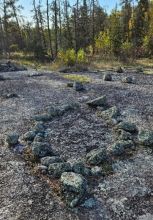
Image: Participants standing in a circle at the Bannock Point Petroforms site (above) and a closeup up at a petroform (below) at Whiteshell Provincial Park.
Photo Credit: Christine Drake

Image: People walk along the Sturgeon River shoreline.
Photo Credit: Karin Smith
Participants also had a chance to visit the Whiteshell Provincial Park Natural History Museum, where they observed the restored original fireplace and chimney, interacted with informative exhibits, spoke with a park interpreter, and ate their lunch outdoors in the amphitheatre.

Image: Exhibit at the Whiteshell Natural History Museum.
Photo Credit: Karin Smith
These field trips offered powerful opportunities to engage with real-world challenges and celebrate the diverse landscapes and cultural narratives that shape Canada’s parks and rivers.
That same afternoon, participants had a chance to circulate throughout the Wilderness Edge lodge and participate in a series of activities, including traditional Inuit games, traditional meal preparation, and a CHRS storytelling activity.
Cultural Ceremony & Country Lunch
On Wednesday evening, Nunavut Parks hosted a traditional Inuit meal that included caribou, beluga whale, candied arctic char, and Bannock, offering participants a hands-on experience in preparing and sharing country food.
Following our shared meal, Kiersten Williams from the Government of Nunavut offered a meaningful demonstration of the qulliq—a traditional Inuit oil lamp historically used for light, heat, and cooking. Kiersten explained its cultural significance and showed how it is carefully lit and maintained, offering participants a deeper appreciation for Inuit knowledge and traditions.


Image: Kiersten Williams, Regional Coordinator, Heritage Appreciation, Nunavut Parks & Special Places, demonstrating the lighting of the qulliq.
Photo Credits: Karin Smith (left) and Lucy Abraham (right)
Leadership Workshops for Students
Leadership Residency participants presented capstone projects addressing real-world challenges in parks and rivers. Other workshops included system design sessions, sector issue prioritization, and collaborative planning with Canadian Parks Council and CHRS leaders.

Image: Don Carruthers Den Hoed holding a timer during one of the leadership workshops.
Photo Credit: Joanne Podolchuk
Canadian Heritage Rivers Field Trip Day

Image: Photo of the Red River’s CHRS plaque at the Forks.
Photo Credit: From the Red River’s 2024 annual report, Government of Manitoba
On Friday, CHRS members explored the Red River, a designated Canadian Heritage River. The trip included an interpretive boat tour by Winnipeg Waterways and an interpretive walk by Parks Canada.


Image: The Winnipeg Waterways fleet (left) and tour guide (right).
Photo Credit: Marleine Gélineau
Trip to Rankin Inlet
From October 10–12, a group of delegates traveled to Rankin Inlet, Nunavut, for a land-based learning experience hosted by Nunavut Parks. Participants visited local sites, engaged with the local parks staff and community members, and deepened their understanding of Indigenous-led conservation.


Image: Nunavut Water Edge (left) and Nunavut Bay & building (right)
Photo Credits: Matt Bowes (left) and Karin Smith (right).
That’s a Wrap!
We are deeply grateful to Nunavut Parks for their leadership, generosity, and cultural sharing throughout Congress 2025. Their efforts made this year’s gathering truly unforgettable.
Stay tuned for updates on Congress 2026, and thank you for your continued dedication to Canada’s parks, rivers, and protected places.

Image: A group of Leadership residents and Canadian Heritage River System members
Photo Credit: Parks Canada